When Your Favourite Author is Dead to You
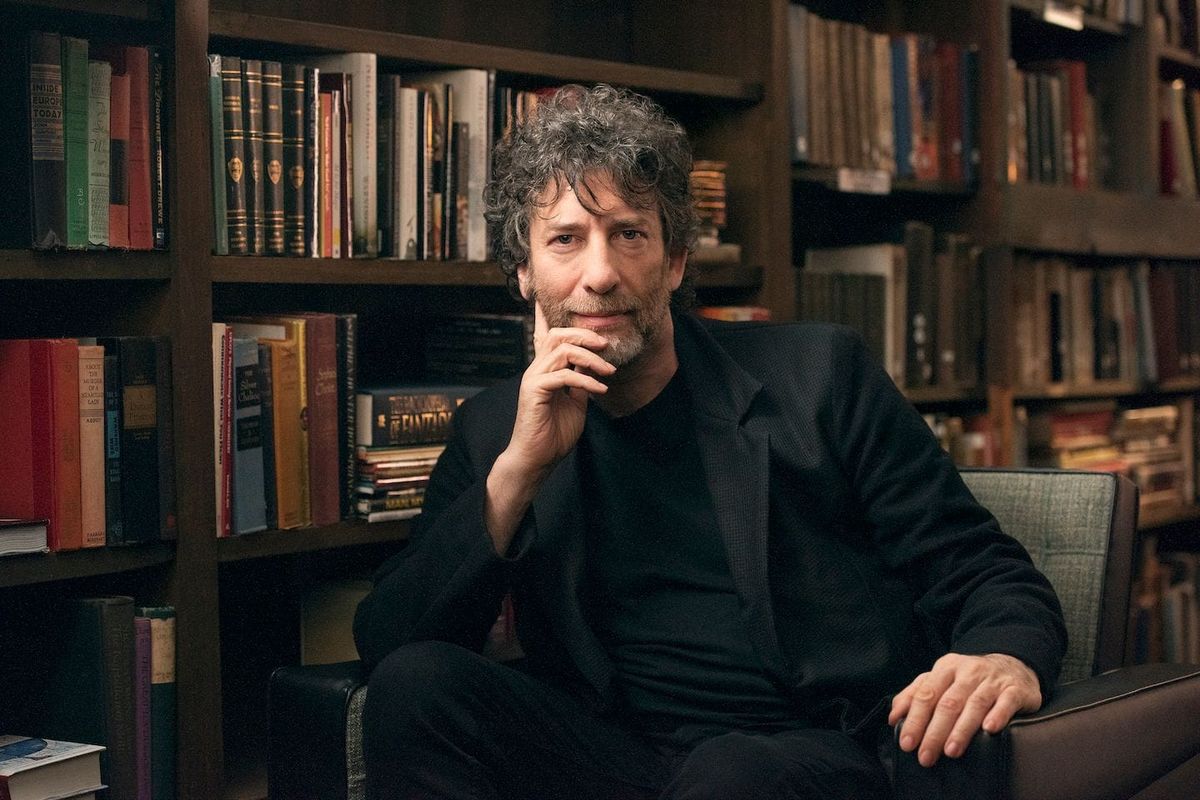
Sex abuse allegations have cast shadows over Neil Gaiman's writing. Where do his readers go from here?
Four years ago, when her then-five-year-old daughter wanted a bedtime story, Kathryn Weber-Boer read her the short story "Cinnamon.” The children's fantasy tale, first published in 1995, is about a young girl who befriends a talking tiger. It felt like a natural choice for Weber-Boer, who had read just about everything else written by the story’s author.
She first encountered his books as a teenager, through his children’s novella Coraline, and then later his novel American Gods, before delving into his other fiction. Eventually, she realized they were all written by the same man: Neil Gaiman, the British fantasist, and creator of the juggernaut Sandman comic series, nearly as well-known for his all-black attire as for his popular works of fiction. He went on to become one of the most celebrated authors of the 21st century.
As a lifelong bibliophile and lover of the ‘classics,’ Weber-Boer held Gaiman in high esteem. His books have shared the same space as Austen’s and Tolstoy’s on the shelves of her home library in the Netherlands.
“I think all his works, including his children’s works, ask whether we are who we think we are,” she told me, “and whether what you suspect to be true about the world is right.”
If Gaiman’s stories evoked these feelings for her, revelations about his past actions would pose those very questions about the man himself.
In July 2024, an investigative podcast from the U.K.-based outlet Tortoise Media released a four-part series sharing the testimonies of two women – Gaiman’s former nanny, and a young fan – who described how he had sexually assaulted them years prior. Both accused him of imposing violent, coercive, and nonconsensual forms of B.D.S.M. that overstepped power dynamics in their relationships.
Soon, three more women came forward on the podcast, with their own strikingly similar accusations in additional episodes. Gaiman denied that any of these instances were nonconsensual (and does so up until now), but the news created a stir within his global fan community and led the production of a few of his film and TV show adaptations to be stalled.
Six months later, Vulture published a bombshell exposé expanding on much of Tortoise’s original reporting, with new corroborating sources close to Gaiman. It led to a public firestorm for the megastar author, with long-time publishers cancelling reprints of his books, and even some bookstores taking his name down from their storefronts. It also left fans like Weber-Boer personally torn. "This is a weird way of saying it, but this couldn't have happened to a worse person," she told me.
One of Gaiman’s accusers sued him at the start of the year, in an ongoing legal case. But beyond the courtroom, the public has litigated his case as well.
Neil Gaiman is a literary behemoth: an author who’s sold millions of books, won every award for fantasy and science fiction writing the industry has to offer, and defined popular fiction in a way that only an equally tarnished name like J.K. Rowling could even match.
But even beyond his works, he’s known as a veritable demigod on Tumblr, a vocal supporter of women’s rights, an ally of the queer community, and a humanitarian who spearheaded numerous charitable causes. He’s a parasocial icon; longtime fans have developed a close connection with him, commonly referring to him as just ‘Neil,’ as if friends on a first-name basis. His words have made careers, and even saved lives.
The revelation of a beloved artist taking morally questionable actions is hardly a new phenomenon. In our post-’MeToo’ age, it’s happened to many of the towering male figures of the entertainment world.
For many fans, including me, this case has evoked strong and conflicted feelings. Maybe it’s because Gaiman has long been viewed as part of, and in many ways invited comparisons to, his fiction. The inseparability of these two ideas is his most defining attribute, and it will complicate his legacy going forward, as we begin to re-evaluate him and his works.
As Marvel comic book writer Scott Gray said, soon after the allegations, "The most convincing character Neil Gaiman ever created was 'Neil Gaiman'."
In his immortal 1967 essay “The Death of the Author,” Roland Barthes introduced the eponymous theory of post-modern literary analysis. He famously decreed that the reader can only be “born” from the author’s titular demise – or, in other words, empowering readers by refusing an author any authority over their text. Crucially, this new critical approach rendered moot the readings of texts through an autobiographical lens.
A version of Barthes' idea has persisted until the present, influencing how we choose to interpret not just novels, but a variety of other fictional media. This includes the increasingly popular refrain of “separating the art from the artist.”
Whether a consumer separates the hand behind the page or stage from the art they produce remains an individual choice. Likewise, it’s nothing new for audiences to re-evaluate creators they once loved in the wake of outdated views, publicized prejudices, or past misconduct. In recent years, within the imaginative fiction genres, everyone from J.K. Rowling to Roald Dahl has been cast under new scrutiny.
But for Neil Gaiman, the line between art and author has always been blurred at best. He was an author who vied for commercial success, working in popular genres, but he also aspired to gain lasting literary authorship. The transcendent ability to shape how readers interpret a text has long enchanted him. If his writing career had a single guiding principle, it was the pursuit of that authority.
Gaiman has described this fascination in his earliest literary influences. “It was the first time I ever realized that somebody was really writing this stuff,” he said, recounting his first time reading The Chronicles of Narnia books as a child. “[C.S. Lewis] would do things like parenthetical asides, put these things in brackets. And I could go, ‘There’s somebody here. There’s an author. He’s doing this!’ ” It made him wonder if he could be an author as well.
As a young adult, Gaiman worked as a freelance journalist, immersed in Britain’s counterculture literary scene in the ‘80s, before entering the world of comic books. He connected with compatriot Alan Moore, whose works like Watchmen brought the medium a new literary clout. As part of the ‘British Invasion’ of the comics industry, Gaiman would soon join this creative wave, becoming one of its flagship auteurs.
In 1987, he embarked on his first collaboration with artist Dave McKean to make the graphic novel Violent Cases. The story depicted an illustrated narrator, made explicitly to resemble Gaiman, recounting past events that comprise the main narrative. Gaiman would later describe it as a “very unreliable work of autobiography,” confirming that the plot events were largely inspired by his own childhood experiences.
“There’s a metafictional quality that runs through nearly all of Gaiman’s work,” Joe Sutliff Sanders, a Cambridge literature professor who’s written extensively on the author, told me.
Gaiman had long made use of this literary technique – deployed by writers as old as Chaucer, and as refined as Nabokov – to draw attention to the innately fictitious and constructed nature of his stories, and thus extend his authority as a storyteller.
With his newfound critical acclaim from Violent Cases, Gaiman embarked on a new series that would cement his name as an author. In November 1988, DC Comics published the first issue of The Sandman. The titular protagonist, Dream, or “Morpheus,” was one of seven immortal beings called The Endless, and a personification of storytelling.
The series would span into a seven-year-long and critically acclaimed comic book saga. Sandman drew from vast reservoirs of culture and mythology, but the centralizing theme was storytelling itself. Many of the standalone episodes were framed through characters who told those stories, and in doing so, brought those stories to life – not unlike Gaiman himself, as the comic’s author.
Sanders fell in love with Sandman comics as a teenager, and says he can still read and enjoy the works, while also acknowledging the author’s alleged real-world harm that has now surfaced. But he concedes that for many other readers, this may not be seamless.
"I think because his stories tend to thin the wall between fiction and reality,” Sanders told me, “it's going to be especially difficult to separate how we feel about the fiction from how we feel about the author.”
Sandman’s seventeenth issue, “Calliope,” follows a human author named Richard Madoc who enslaves and repeatedly rapes the Greek muse of poetry, personified as a young woman, to achieve inspiration and literary fame.
Gaiman has often said that every character he’s written contains a part of him (he called his black-clad protagonist Dream “me-ish.”) That doesn’t make any of them literal stand-ins for him nor his actions. But his career-long interest in positioning himself as the omniscient storyteller has made the distinction difficult. Perhaps, contrary to Barthes’ assertion, the author can’t be “dead,” if he’s consciously made himself the text.
In the summer of 2024, with the new school year approaching, Tara Prescott-Johnson had looked forward to teaching her annual seminar on Neil Gaiman.
While she was on vacation, her friends and close connections began texting her, asking if she’d heard about “the news.” That’s how she first learned about Gaiman’s allegations. “I think, like a lot of people, my initial reaction was hoping it wasn’t true,” Prescott-Johnson told me.
As a fan, she’d spent decades of her life immersed in Gaiman’s fictional worlds – but she had also built much of her career around his body of work. As a literary academic, she’d written many essays and edited two anthologies of criticism on his fiction, including one called Feminism in the Worlds of Neil Gaiman.
She had introduced a seminar course on his books at UCLA in 2016, and it had been her favourite class to teach ever since. The revelations about Gaiman’s alleged misconduct gave her pause.
“I realized I couldn’t bring myself to teach a course where I was introducing new students to his work,” she told me. “I would have had to help them navigate their response to it, while I was still trying to figure out mine.”
Over the next few months, Gaiman’s sudden fall from grace caused Prescott-Johnson to question choices that had once seemed as natural to her as breathing. Should she wear her t-shirt displaying Gaiman alongside the members of FourPlay String Quartet, made during his 2023 collaboration with the musicians? Should she watch the fifteenth anniversary screening of the Coraline film in theaters?
Even when she was teaching her modified course, which now heavily de-emphasized Gaiman’s books, she had to resist the urge to constantly reference him. “I didn’t realize how much he’s the person I reach to when I talk about writing,” she told me.
His books had been a touchstone for her as a teenager in the ‘90s, when she first discovered Sandman. As with many new female comic book readers at the time, she’d been drawn into Gaiman’s more inclusive world within a traditionally male-dominated readership. In the series, he portrayed female characters like Dream’s sister, Death, who went beyond stereotypes and statuses as sex objects, possessing agency in their own right.
In a 2012 essay analyzing Sandman’s infamous “Calliope” story, Prescott-Johnson even argued that it could be read from a feminist lens. After all, the story ends with the abusive author being brought to divine justice for his lurid crimes against the woman he held captive.
Through the allegory of “Calliope,” Prescott-Johnson wrote, “Gaiman asks readers to more actively question which authors and works they read as ‘feminist’ – including his own.” Her words proved far more accurate than she could have ever expected.
Nalo Hopkinson, an award-winning Canadian speculative fiction author and UBC creative writing professor, faced a similar dilemma. “I removed many of his books from my shelves,” she told me. “The problem is, I’m in some of them.”
As colleagues in the fantasy author community, they shared far more than shelf space. Hopkinson had known Gaiman for years. She had published his short stories in anthologies, and had even written a comic series in 2018 called House of Whispers, set within the Sandman universe. Her most recent novel, Blackheart Man, had Gaiman’s blurb on the cover.
When she learned about the allegations, she asked her publisher to remove it from the cover of all subsequent reprints.
“If you’re a big reader of anything,” Hopkinson told me. “Your shelves are probably filled with books by authors who have been abusive at some point in their lives.”
But for her, as with many others, this one hurt like a blow to the chest – especially because it was an author whom she thought she knew.
The first Neil Gaiman book I read was American Gods, when I was 17. My older sister’s friend had gifted me the novel at Christmas that year. Before then, my only association with the man was as the author of Coraline, who appeared in a character’s falafel during his cameo on the children’s show Arthur.
For young adults of my generation who grew up reading mythological fantasy novels, Gaiman felt like the natural destination of the well-greased Rick Riordan pipeline. American Gods was essentially an adult version of the Percy Jackson novels, depicting the divinities of old living among us in the modern day.
I was captivated enough to make my way through the rest of Gaiman’s body of work. For an aspiring fiction writer who loved fantasy, he became my gleaming ideal for success. Here was an imaginative writer, driven by the sheer sincerity and power of storytelling. He never read all of Joseph Campbell’s The Hero With a Thousand Faces, and yet his goal as an author seemed to be capturing the world into a single unifying myth.
In turn, he shaped my literary taste. I read “Preludes and Nocturnes,” the first collected volume of the Sandman series, during the first semester of my undergraduate literature degree, back when I avoided the “Literature of our Time” – the assigned canonical works on my syllabus – to read comic books instead.
One of those works I’d initially balked at reading was T.S. Eliot’s The Waste Land. The epic-length and fragmentary five-part poem is most famous for its opening line, one that proved to be unexpectedly prescient after the 2020 lockdown that bisected my undergrad years into pre- and post-COVID: “April is the cruelest month.”
But it was another lesser-known line from the start of the poem that resonated with me, when I learned later on that Gaiman had cribbed it for Sandman’s original tagline: “I will show you fear in a handful of dust.”
It was a subtle inclusion, one that I only clocked much later, after moving on from nodding terms with the literary classics to being somewhat well-acquainted. But for me, it signaled Gaiman’s creative intentions. As Eliot did in The Waste Land, Sandman borrowed from the wide-spanning literary canon – the Bible, Shakespeare, and other ‘high culture’ properties – to foreground the universal power of narrative.
I envied and emulated that trait. In my own short stories and poems, I grasped for literary maximalism, relying on the ‘great stories’ of the past to imbue my own with greater significance. Through Gaiman, my reading taste matured; I graduated from the YA fantasy and superhero comics that defined my young reading diet to more ‘serious’ literature.
There’s no individual author over whom I’ve shed more words of analysis. Gaiman began his career as a journalist who wrote about other great authors and aspired to be one. I thought to myself, ‘Why can’t I be the same?’
When Netflix’s Sandman premiered in August 2022, my friend Winston and I watched it in a heartbeat. We focused far more on the casting and other adaptational choices than delving into the hidden implications for its creator.
“As much as you think you know someone through their work, you don’t really know shit about them, right?” my friend, Winston, suggested. (He preferred to use a pseudonym.)
We first met through a class in undergrad, and soon learned about our shared love of the Sandman comics. It became the foundation for our friendship. Winston found the revelations about Gaiman disheartening, but not heartbreaking. “I try not to idolize people,” he told me, “and I think that’s one thing we’ve learned as a society to not do lately, because nobody’s safe.”
He named some of the other usual suspects and their demerits – from Ernest Hemingway’s misogyny, to J.K. Rowling’s transphobic views. Still, despite the new knowledge, he says this wouldn’t stop him from reading Gaiman’s books now. “To be honest, I’ve never had a problem with separating the art from the artist,” Winston said.
But R.W.W. Greene, an English teacher and prolific sci-fi novelist, feels differently. “‘Disappointment’ is not strong enough of a word,” he told me. As someone who says he’s read everything Gaiman’s ever written, Greene admits, “I’ll probably never recommend his books to anyone without telling them, ‘Keep in mind, this guy’s terrible.’ ”
Even more so for Gaiman’s Sandman, whose protagonist, Dream, an arbiter of storytelling, is easy to read as the author’s self-insertion. “The maker is part of the story,” Greene told me. “And once I know the story of the maker [...] it puts a lens on the art that I’ll never be able to take off.”
It’s an opinion that other long-time fans share. In August, Greene spoke about the Gaiman controversy as a panelist at the World Science Fiction and Fantasy Convention, or ‘Worldcon.’ The annual event has bestowed authors with the Hugo Awards, one of the premier accolades for speculative fiction writing, since 1953 (Gaiman has won 7 of them over the past two decades). But at this year’s gathering in Seattle, even saying his name felt taboo.
“I was actually really surprised,” Tara Prescott-Johnson, the UCLA professor, told me. Walking through the convention stalls, and seeing the lineup of scheduled talks, she noticed how absent Gaiman was from all of it. She gave a presentation on her pivot from teaching her annual seminar on his works in favour of other Hugo Award-winning authors.
When the slide showing Gaiman’s face appeared on the projector screen, she heard a collective wince from the audience.
Before arriving at Worldcon, she’d perused some fan discourse online, reading comments from those who denied Gaiman’s allegations or who she perceived as apologists.
“I was initially bracing myself to be challenged in that way,” Prescott-Johnson told me, coming into the event, but was instead met with more confusion and uncertainty among fans.
Similarly, the establishment’s reaction to Gaiman’s heel turn has varied. In May 2023, the Saint Louis University Library Associates presented him with their annual literary award. Since 1967, they’ve honored many modern luminaries of letters (W.H. Auden, Salman Rushdie, and Margaret Atwood, to name a few) and hosted them at the school.
But following Gaiman’s allegations, some students retroactively questioned his selection.
Edward Ibur, executive director of the school’s literary award committee, said this turn of events has inspired them to consider new selection criteria for future awards, including the idea of a ‘character’ component that examines an author’s integrity beyond their works.
Ibur told me, "The conversation surrounding Gaiman has prompted important reflections on how we consider an author's life and legacy in its entirety.”
Even more so for the author’s wide-spanning fan community. Daniel Guy Fowlkes was part of the first dedicated group of Gaiman fans on the early Internet, colloquially dubbed “the Thingies.” After connecting with Gaiman in the early 2000s, Fowlkes came to run the author’s website, and then later his official Facebook fan group.
But Fowlkes found himself in a difficult position after July 2024, when the allegations led to the exodus of almost all his fellow group moderators.
As more information came out about the Gaiman case, heated discussions ensued among fans. “We just wanted to keep it civil, but it was hard at first,” Fowlkes told me. With his remaining co-moderator, Paul Masters, he had to block posts from or remove some especially vitriolic members, whether they were ardent Gaiman defenders or detractors.
Fowlkes and Masters later decided to rename the “Fans of Neil Gaiman” group, after conducting a poll of their users, to “Fans of the Works of Neil Gaiman.”
It may read as a minor difference, but it signaled their interest in maintaining a healthy community discourse. Fowlkes felt that, regardless of what facts are revealed about his personal history, “We shouldn’t be here to fawn over Neil,” he told me. “We should be here to discuss his work.”
Fowlkes wants the truth about the allegations to come out. The Gaiman whom he’s known for decades, he says, doesn’t align with the person who has been portrayed in recent reporting.
But he also understands that not knowing about events doesn’t mean that they might not have occurred, and that others in the author’s close orbit may be questioning who they thought of as the “real Neil,” in light of recent developments.
“We’re a community of thought and ideas,” said the author Nalo Hopkinson. “We talk things through. I have great faith that we’re not going to let this case go silently.”
But individual members of that community also have a choice to make.
Samara Serotkin has been a practicing therapist for over twenty-five years, but she’s read Neil Gaiman’s books for even longer. After learning about the allegations, she felt incensed at him.
When Serotkin first read the Sandman comics years ago, she found his works to be inclusive and a “safe space.” But who the “real” Gaiman turned out to be shattered that image. Many of her clients who were fellow fans shared those concerns.
As a mindfulness-based psychologist, Serotkin has incorporated fictional media into her long-time clinical practice — using characters from books and films to help her clients explore and better understand parts of themselves.
The first season of Netflix’s Sandman offered plenty of material for self-reflection. But since Gaiman’s public disgrace, through more recent sessions with her clients, she’s found a different way to process her feelings about the author.
Even now, she says, many of her clients still find value in Sandman and what the stories have to offer them. She references one specific client who continues to draw hope from an episode of the series, in which the very notion of “hope” itself is enough for Dream, the titular protagonist, to escape from Hell.
It feels like an apt metaphor for many jaded Gaiman fans, trying to move past the real-world controversy and return to a story they once loved. “It makes me want to find ways not to throw him out,” Serotkin told me. “But I’m still not sure how I want to engage with his works going forward.” For her, it remains an ongoing and individual choice to embrace the positive parts of his books, and to put aside the author who wrote them.
She’s not the only one. Tara Prescott-Johnson was editing a collection of essays on the show’s first season well before the news first broke about the allegations. The book, Streaming The Sandman, was published earlier this month.
“I had already decided this would be my last book on his works,” she told me. “Now, it just feels especially final.”
She’s taken solace in her conversations with colleagues and friends about artists in other fields, from Bill Cosby to Joss Whedon, who turned out to be far less ideal people than their art suggested.
This past summer, Prescott-Johnson was at her usual vacation spot in upstate New York, where she’d first learned the news about Gaiman the year before.
At a community lending library, she came across two copies of The Ocean at the End of the Lane. She’s long considered it her favourite of Gaiman’s books, one that the author has often called his most autobiographical story.
“At first, I felt like I had to take [the books] home and adopt them,” Prescott-Johnson said. She recounted this with a sparkle in her eyes, as if the memory of when she first cracked open Ocean was buoying her spirit. But at that moment, she decided to let the books be.
“I probably will re-read it eventually, but not right now.”
The one time I saw Neil Gaiman in person, he was reading someone else’s words. He headlined an event in New York City that was celebrating the life of Ray Bradbury, and read some of the late American author’s acclaimed short stories to a rapt audience.
For many readers, Gaiman’s voice is as recognizable as his prose. “I’ve always felt like you could read his work with his voice in your head,” said Kathryn Weber-Boer, the lifelong fan who read the short story “Cinnamon” to her daughter.
“Every book is so clearly his writing,” she told me, “and I don’t think there’s anything else I’ve read that comes through so clearly as the author’s voice.”
More than a year out from the controversy, she’s continued to read stories to her now-eight-year-old daughter, but not Gaiman’s. It hasn’t been a conscious avoidance. “If she picked a book of his off the shelf and wanted to read it, I wouldn’t say no,” Weber-Boer told me. But she’s enjoyed reading other authors to her daughter in the meantime.
Gaiman has narrated most of the audiobook adaptations of his work. Over the past year, as I’ve revisited his books, his voice has literally run through my head.
My favourite words he’s ever written came from “A Midsummer Night’s Dream,” the episode of Audible’s 2020 adaptation of Sandman, based on the nineteenth issue from the comic series of the same name.
I listened to it during an afternoon walk around my neighbourhood, during that strange summer of social distancing, and eventually remote school, when my growing up seemed to be on hold. I’d been back at my childhood home since that March, which was on a street address called, funnily enough, Sandman Crescent.
I made my daily trek to the nearby playground on a cloudy day, the story playing through my ear buds. Then came the story’s final lines: “Hamnet Shakespeare died in 1596, aged eleven. Robin Goodfellow’s present whereabouts are unknown.”
Two terse statements that sealed the fates of two beings – an individual from history, and one from world literature – both shaped by Gaiman’s imagination.
I still don’t completely understand why these lines struck me, and no amount of literary analysis has helped me to. But when he spoke these lines from his comic, it felt like he was, at least partially, speaking to me.
It was tempting to end this essay with any number of his famous words. Now, I feel the author doesn’t need to have the final word.
When I first heard those lines from Sandman #19, I was on the swings, in the middle of a sandbox, suspended between late adolescence, and whatever stage came next. Then, it started drizzling.
Comments ()