Freedom of the Press (Within Reason): The West Wing’s Polite Censorship
In Sorkin’s Camelot, the Fourth Estate is welcome only when it kneels.
If there ever was a face of the eight-year-long, beleaguered Bartlet administration, plagued by a self-fulfilling persecution complex, it would have to be the one and only Claudia Jean Cregg — the White House press secretary, also known as C.J., also known as the “Jackal”, also known as a gold fish aficionado (the woman contains multitudes). Despite the clumsy staff reshufflings of the later seasons, I will always remember her standing tall and proud at her lectern, ready to efficiently dismiss valid inquiries, stamp out journalistic dissent, or benevolently bestow offhanded facts from Claudia Jean’s house of useless knowledge.
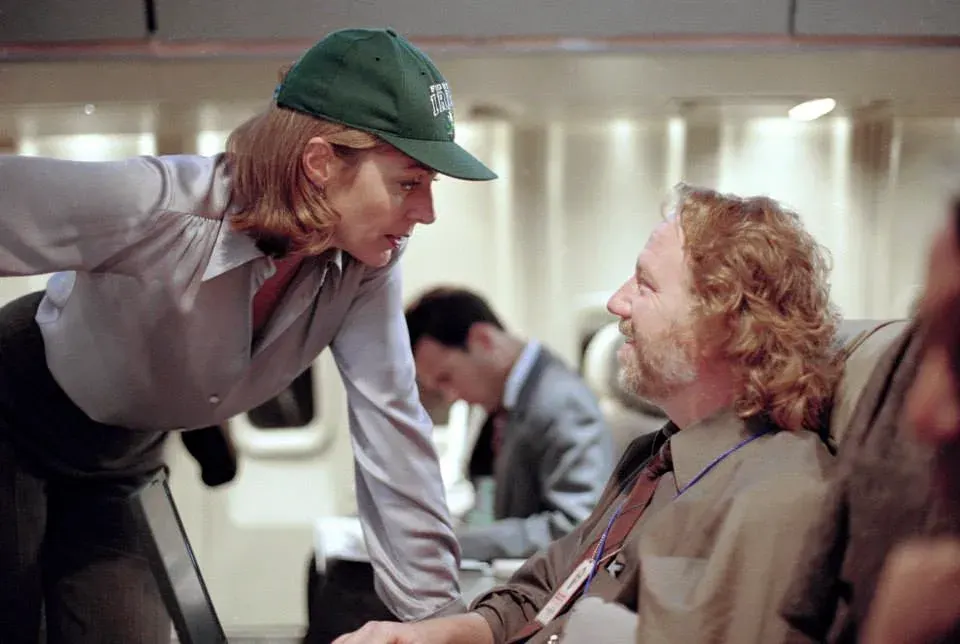
The nineteenth episode of the show’s fourth season, “Angel Maintenance,” gives us a minor crisis, with a mid-flight landing-gear malfunction, but gestures at something larger: whether it is, in fact, better for the public not to know certain things. As C.J. tries, in a slapstick manner, to draw away the attention of journalists aboard Air Force One from the life-threatening situation facing them and then begs, borrows, lies, and steals to prevent them from contacting their editors on the ground and breaking the story, The West Wing touches on something deeper. The episode toys with the balance between security and accountability, the tightrope on which democratic governance supposedly rests. It’s an uneasy question, and one that — if the show had any genuine appetite for discomfort — could have been its central theme. Instead, it’s drowned beneath W.G. Snuffy Walden’s swelling score and the reassuring hum of competence.
The show, for a brief moment, seems self-aware. Season five’s “Access” is a hamfisted attempt to rationalize C.J.’s despotic desire for control of the narrative. A documentary crew is given nearly full access to the White House and its press secretary to show the real rigour of the role. There, C.J. is not the self-assured harbinger of disaster and bestower of truth, strutting through the halls. She’s hesitant, self-doubting, stutters, and grapples with the dichotomy of her job. She even claims, at a certain point, that her role is to inform the public, and not mislead them. But you can’t be a servant of two masters – both presenting straight facts and spinning the administrative narrative. Claudia Jean chose her allegiance, and the series rewards her for it. What could have been a meditation on the ethics of power becomes, instead, a quiet justification for it. It might have been poignant, even brave, if The West Wing weren’t so invested in proving that its apparatchiks — by virtue of their proximity to the messianic glow of Josiah Bartlet — are always right. Yet, much like the fictional filter that C.J. represents between the public and their well-meaning president, she is only the tip of the iceberg when it comes to the show’s deeply paternalistic view of journalism and the people it claims to serve.
Perhaps the most telling illustration of The West Wing’s cavalier attitude towards freedom of expression comes at the end of the third season, in “Enemies Foreign and Domestic.” In anticipation of a meeting between President Bartlet and his Russian counterpart, President Chigorin (who happens to be a former KGB agent attempting reforms), Toby Ziegler faces a moral dilemma: whether to grant White House press access to Ludmilla Koss, a journalist blacklisted by the Kremlin. The premise seems simple — Americans, after all, are the standard-bearers of liberty. Yet the twist comes swiftly: Ludmilla was denied accreditation not for her political views, but for writing tabloid stories about the president’s mother-in-law. Gauche. Intrusive. Uncouth. Cue Toby’s sanctimonious scolding and the show’s collective sigh of moral superiority.
The irony, of course, is that Ludmilla works for Novaya Gazeta, the real-life, battle-hardened publication whose editor-in-chief Dmitry Muratov won the 2021 Nobel Peace Prize for “efforts to safeguard freedom of expression, which is a precondition for democracy and lasting peace”. Since then, we’ve learned that nearly every top Russian official launders their wealth through family members to avoid sanctions, hide their innumerable treasures, and continue with their bon vivant lifestyles, precisely the sort of scrutiny Novaya Gazeta once dared to provide. The episode aired in 2002, two years into Vladimir Putin’s first term. Even then, the show’s inability to see the journalist as anything but an inconvenience was striking.
Toby himself wasn't spared either. In the later seasons, he leaks what by current standards would be considered very tame information regarding a military space shuttle and is publicly crucified for it, only being saved by an eleventh-hour presidential pardon. Yet earlier in the series, the President, First Lady, and Chief of Staff deliberately conceal then-Governor Bartlet’s Multiple Sclerosis diagnosis from the American electorate, and only get a slap on the wrist in the form of a congressional censure. How perfectly quaint by current standards and yet apt in the showcase of no responsibility from the ruling elites whatsoever. Once again, was it all fine because this was done by the “good guys”? The message is clear: accountability is for the press, not for power. The moral calculus is inverted — leaks are sins, cover-ups are character arcs.
In our current world — where journalists sign “loyalty pledges” or lose Pentagon access, where every syllable from Press Secretary Karoline Leavitt's lacquered lips drips with condescension, and where reporters are imprisoned or dismembered in embassies — the fantasy of The West Wing feels almost indecent. Its vision of a noble press corps, chastened and polite before benevolent authority, now reads less like aspiration than indoctrination.
Two decades on, C.J. Cregg remains one of television’s most beloved depictions of a press secretary — competent, quick-witted, compassionate. But that affection is precisely the problem. Her charisma makes censorship palatable. Her authority makes manipulation look like stewardship. And her loyalty makes obedience seem noble. The West Wing didn’t just soften the image of government — it tamed the watchdog meant to keep it in check.
Because in Sorkin’s America, the press is free only so long as it behaves itself.
Comments ()