The West Wing Revisited: A Camelot for the Neoliberal Age
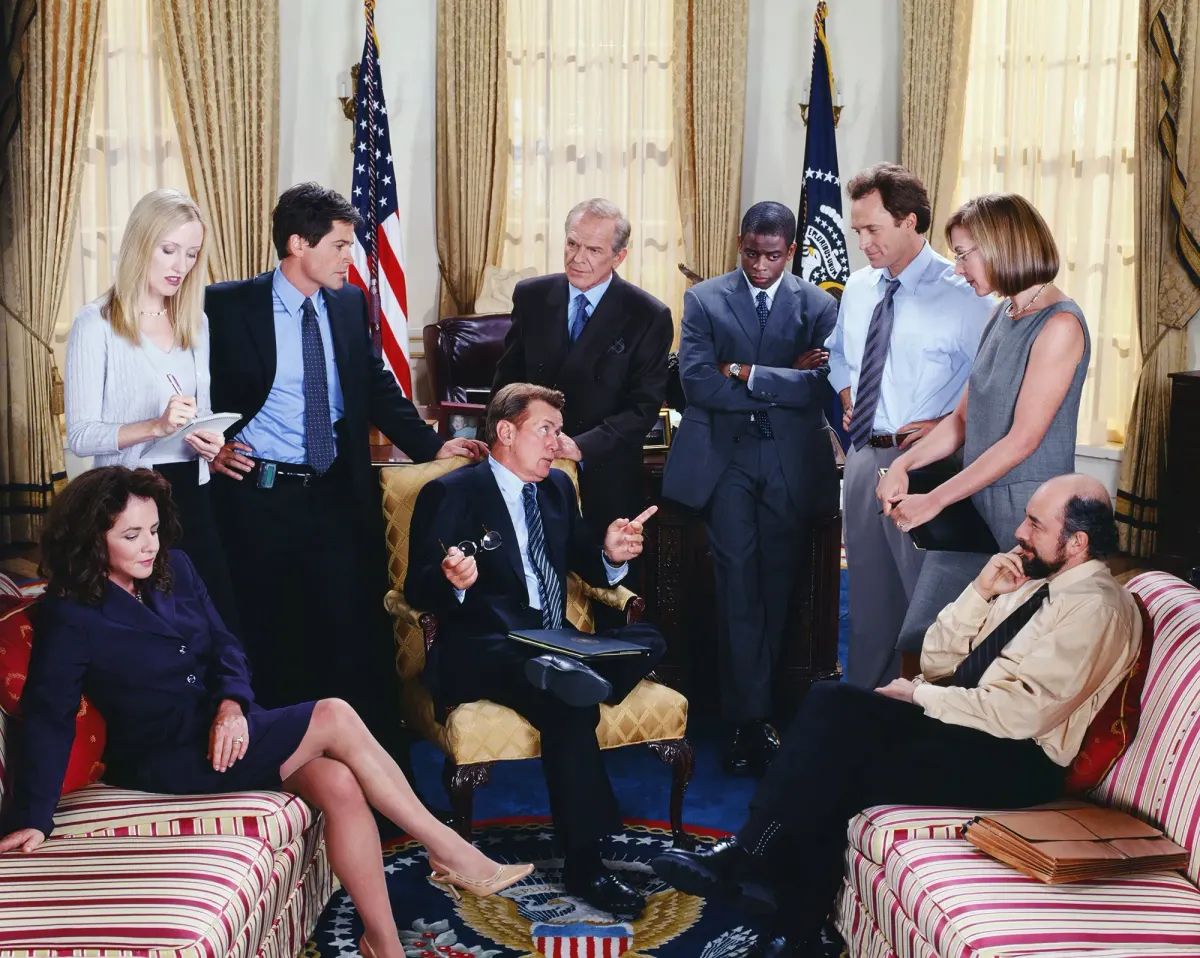
Once seen as a beacon of hope and idealism, The West Wing now reveals a more unsettling truth—one of soft authoritarianism cloaked in good intentions. Twenty-five years on, it deserves a second look.
Every once in a while comes a piece of media so poignant, so timely, so self-referential that it ends up preserving the time in which it was created like a stagnant and immutable snow globe. Nothing was quite able to capture the essence of an era like Aaron Sorkin’s The West Wing. Looking back at the late 1990s and early 2000s (which I, born in the year of Our Lord 2000, could in no way witness—much less remember), it seems like those years were clad in satin. An era of hope, of softness, of a clear right and wrong. It had, of course, like any era, its challenges and tragedies. But nothing seemed too big to overcome. The world, after all, was opening up. Communism had fallen, a new era of global communication was creeping in with each breath, prosperity and peace seemed inevitable. The ‘End of History,’ as Fukuyama had promised, was well and truly upon us. The West Wing captures this spirit so perfectly, one might wonder whether it was a deliberate archeological relic.
It is true, The West Wing occupies a curious spot within its creator’s illustrious and rose-coloured portfolio. Nestled in between the hardly heard of Sports Night and exhaustingly dissected The Newsroom, it is the shining jewel that Sorkin could never recreate. A magnum opus he hopelessly tried to add on with endeavors such as Molly’s Game and The Newsroom.
I must admit that I was not among the stalwart disciples of Sorkin’s work. Plagued by youthful ideals of free speech, I believed that journalism—only journalism—was going to save the world, if anything at all could. Thus, I gulped down The Newsroom with the thirst of a neophyte—bowing at the altar of the master. My first exposure to The West Wing was unwilling and at the hands of my Grade 11 law teacher, who put before our underdeveloped eyes the ‘screaming-at-God’ scene from Two Cathedrals. I then went back to the show and its comforting rhythm sometime in my undergrad—revelling in its positivistic predestiny.
Imagine my surprise when, on a rewatch following my graduate studies in Comparative Politics, I was completely paralyzed. This wasn’t an idealized and hyped up version of bureaucracy I was witnessing—it was unmitigated, bone-chilling horror.
Yes, dear reader—do not let the pretty faces of Rob Lowe and Bradley Whitford as well as masterful performances by Martin Sheen and Allison Janey distract you. What we are witnessing in The West Wing—the show that I unknowingly idealized and thought was a harmless piece of political commentary—is the slow and inexorable slide into authoritarianism. It is a masterful example of democratic backsliding and the seemingly innocuous and well-meaning actions that enable it.
Let us simply take stock—a man takes the highest office in the U.S., strains against the confines of the system within which he has to work, gathers a small group of staff and advisors around him who follow him with cult-like devotion, and begins to concentrate power around the executive under the guise of cutting through the red tape. It seems all too familiar. The key difference is, of course, that President Bartlet is an esteemed economist and Democrat—so all is good here, really, nothing to see. And that’s not even mentioning the nepotism.
That’s not to say that the Bartlet administration is the Trump White House, but in blue—certain standards and checks were still upheld. But it does rhyme. Thus, armed with a MSc in Comparative Politics from the LSE (President Bartlet’s alma mater, for full transparency and disclosure) and with the veneer of idealism slightly chipped but not ruined, I will seek to deconstruct The West Wing a quarter of a century later, compare it to the times at hand, and hold President Josiah Bartlet and his political operatives to account. From freedom of the press, to international intervention, to bipartisanship, to the role of women in the White House—no subject shall be free from my scrutiny. An arduous task? Most definitely. One worthwhile? We’ll see how it goes.
In our time of post-truth and subjective reality, it is seductive to give in to the ideals of impartiality and just authority—a great philosopher king. To retreat behind the walls of the great Camelot of neoliberalism. Yes, while the beautifully written speeches and hopeful appeals to lofty ideals lull us into a sense of moral superiority and complacent comfort—assuring that everything will be okay—remember that none of it saved us. We are not living two and a half decades on from the Bartlet administration. Our era is our own.
Rewatching The West Wing today is like a letter you wrote to your older self—full of naivety and alarming idealism. What once passed as moral clarity now flickers as ideological rigidity. The soaring monologues and righteous confrontations feel, in hindsight, less like political idealism and more like a subtle blueprint for executive overreach—granted, an overreach performed in iambic pentameter by men in good suits.
This is not to say the show should be discarded. Quite the opposite. Like any powerful cultural artifact, The West Wing deserves to be examined with both affection and skepticism. It remains a brilliant piece of television, impeccably written, acted, and structured. But brilliance does not equal benevolence. The show's seductive packaging of centrism, technocracy, and "smart people know best" politics is not just an artifact of a bygone era—it’s a warning.
If we truly believe in democracy, scrutiny must be applied not only to our enemies but to our heroes. Especially the well-spoken, charming, educated ones. Because, as The West Wing proves, it’s often not the loudest threats to democracy we should fear—but the quiet, well-intentioned ones we never thought to question.


Comments ()