
Famous Footsteps
Downtown walking tours shed light on local Black history.
At the beginning of the history walk on Nathan Phillips Square, Pamella Houston gave it straight. “I’m not your typical tour guide, with dates, names, or numbers all perfectly memorized,” she told her tour group.
On that sweltering Wednesday afternoon in July, twelve Hydro One employees sat in the slices of shade under the TORONTO sign’s letters and listened to her. Tourists flocked around them, looked for respite from the heat, and took selfies in front of local landmarks—but probably not the ones Houston’s group was about to see.
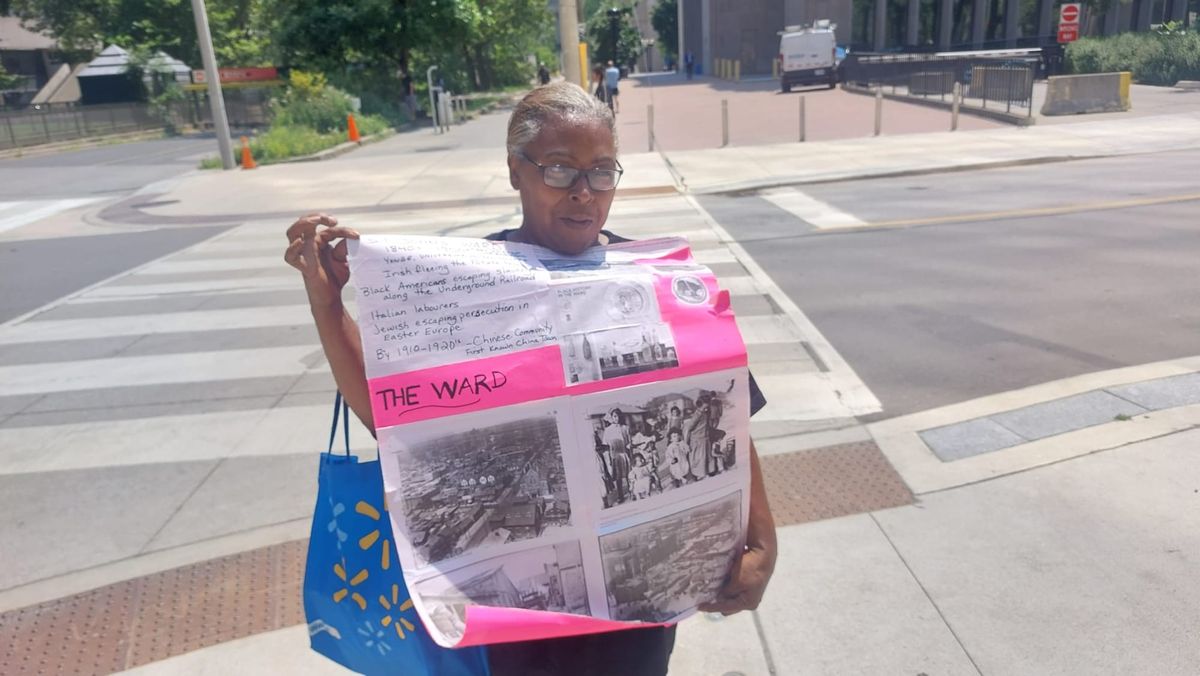
The tour guide, a sprightly 58 years of age, brandished a pink Bristol board, pasted with black-and-white photos and facts about the neighbourhood once known as ‘the Ward,’ the city’s immigrant enclave. In the heart of downtown, circling City Hall, lay traces of the oft-forgotten minorities who lived here centuries ago—informational plaques telling stories of past lives, but also easy to walk past without grokking.
For instance, down the street, next to the Ontario Court of Justice, was the site of a recently excavated British Methodist Episcopal Church, built 180 years ago for the city’s burgeoning Black congregation. It was an essential node in the Underground Railroad, but not a history your average local would know.
That’s why, through the Ontario Black History Society, Houston has tried to bring attention to these landmarks. During her walking tours, it’s common for her to stop anyone she sees along the way, whether pedestrians or police officers, to enlighten them with some historical knowledge.
“I leave a little trail that might ignite something,” she told me. “They’ll chat and tell their friends, and before you know it, we get phone calls from people asking for tours.”
Houston has acted as a tour guide for high school students, working professionals, and even the occasional Hollywood celebrity. She loves telling the anecdote about meeting Chris Rock, while the comedian was in town for a film shoot, and giving him a half-hour tour of the O.B.H.S.’s office on 10 Adelaide Street East. She even playfully slapped him on the arm (“I hit him before Will Smith did,” Houston recounted with pride.)
The Hydro One group was there for a special company outing, courtesy of an internal group called the Black Employee Resource Circle (BERC), a DEI initiative formed to help Black employees develop a sense of workplace community.
For employees like Awoba Wallace, the walking tour was an eye-opening experience. “I’ve actually never thought very much about it,” she told me, when referring to Black Canadian history. She’d been living in Toronto for over a decade, but grew up in Nigeria. In high school, she was only taught about Black history in America.
Kathy Grant, Houston’s co-leader on this tour and a former O.B.H.S. vice-president, could understand. “I think people are surprised to learn that there’s so much Black history here in Canada, as opposed to the U.S.,” she told me. As a public historian and founder of Legacy Voices, Grant has made it her mission to raise awareness of Black contributions to Canada’s defining chapters as a nation.
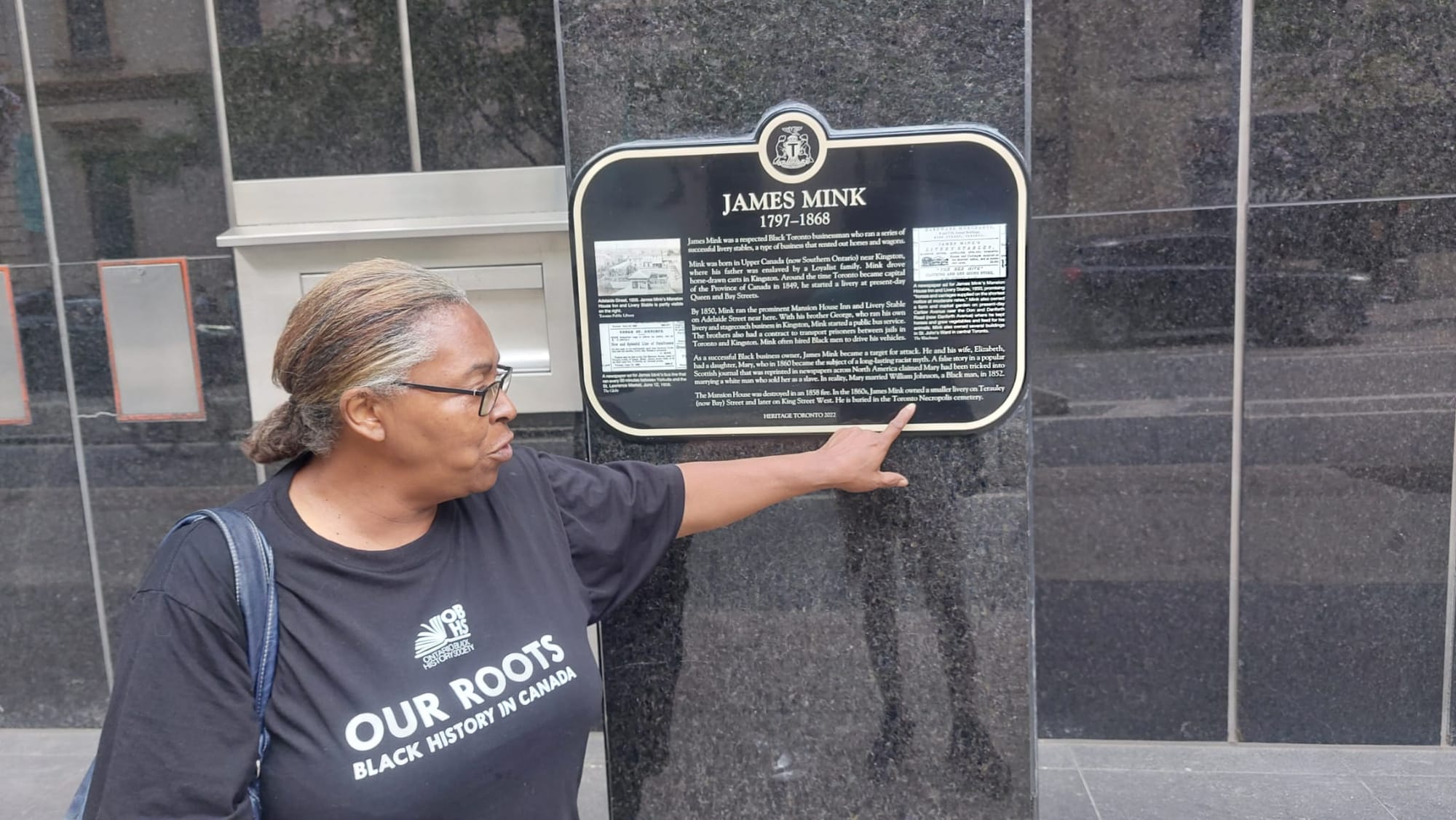
These downtown walking tours, originally conceived as bus tours, aim to do the same. Houston ushered the group from spot to spot, practically bouncing, reeling off commentary, with an endearing way of voicing the thoughts likely on everyone’s minds. “I’m getting delirious from this heat,” she said, leading the tour group into the air-conditioned courthouse.
As Houston admitted up front, she’s not a trained historian, and isn’t big on rote memorization of dates. But after years of self-study, she’s gleaned enough knowledge to become an accessible authority—less a stodgy professor in a dusty office than a friendly peer who you could share a drink with in your favourite local pub.
Near Osgoode Hall was the spot of another historic episode, which Houston recounted. In 1853, she told me, a slave named John Anderson (nee Jack Burrows) killed a White man while escaping from Missouri. Having built his new life in Canada, the freed man and fugitive was later arrested and tried for his crime. The Ontario court ruled not to extradite Anderson to the United States.
It was a landmark ruling in Black Canadian history, and one that Houston could relate to because of her own lineage. She was born and raised in Toronto, but traces her maternal ancestry back to Owen Sound, a small town in southwestern Ontario. This is where her great-great-grandfather, John Green, eventually settled after escaping from his enslavement in Maryland.
Learning more about her roots has been Houston’s lifelong journey, one that began ever since she first walked into the O.B.H.S. office as a child. This was when she witnessed a massive photo hanging there, of Black children at a schoolhouse in North Buxton, Ontario—a historical settlement for recently escaped slaves in the province during the mid-19th century.
“It was my own history,” Houston told me. “I’m from Toronto, and I thought, ‘I’ve never learned about Ontario’s Black history.’ ”
She wasn’t alone in that experience. Even today, an Ontario student can go through their entire education, up until Grade 12, learning little about Black Canadian history, save for the broadest strokes about slavery and suffering. They wouldn’t know about Thornton and Lucie Blackburn, the couple who founded Toronto’s first taxi cab service in 1837; nor Rubin “Hurricane” Carter, the American heavyweight boxer who was imprisoned for a murder he didn’t commit, later emigrating to Toronto and helping to free wrongly-convicted Canadians out of an office on King Street.
But the remnants of this uplifting history are everywhere, in plaques on the corners of buildings, next to Indochino branches and other stores, in the heart of Toronto’s Financial District. As a tour guide, Houston’s goal is to point these out, to share a history that may otherwise be overlooked. She often tells her tour groups, “If you remember one thing I taught you today, my job is done.”
The O.B.H.S. has pursued this very goal since its founding in 1978: to preserve and promote Black Canadian history, educating the wider public. Houston’s mother had worked as a secretary at the non-profit organization after her retirement, and Houston herself grew up coming into the office. This early exposure stoked her interest in learning about her family’s history. Now, as a tour guide, she’s retreading her familial path in more ways than one.
Keeping pace with their schedule, Houston led them down Yonge, toward the office on Adelaide Street. Viola Desmond’s gaze was visible from a distance. As we approach a mailbox at the intersection, on which the portrait was printed, the pointillist dots that comprise the iconic ten-dollar bill’s face become abstracted.
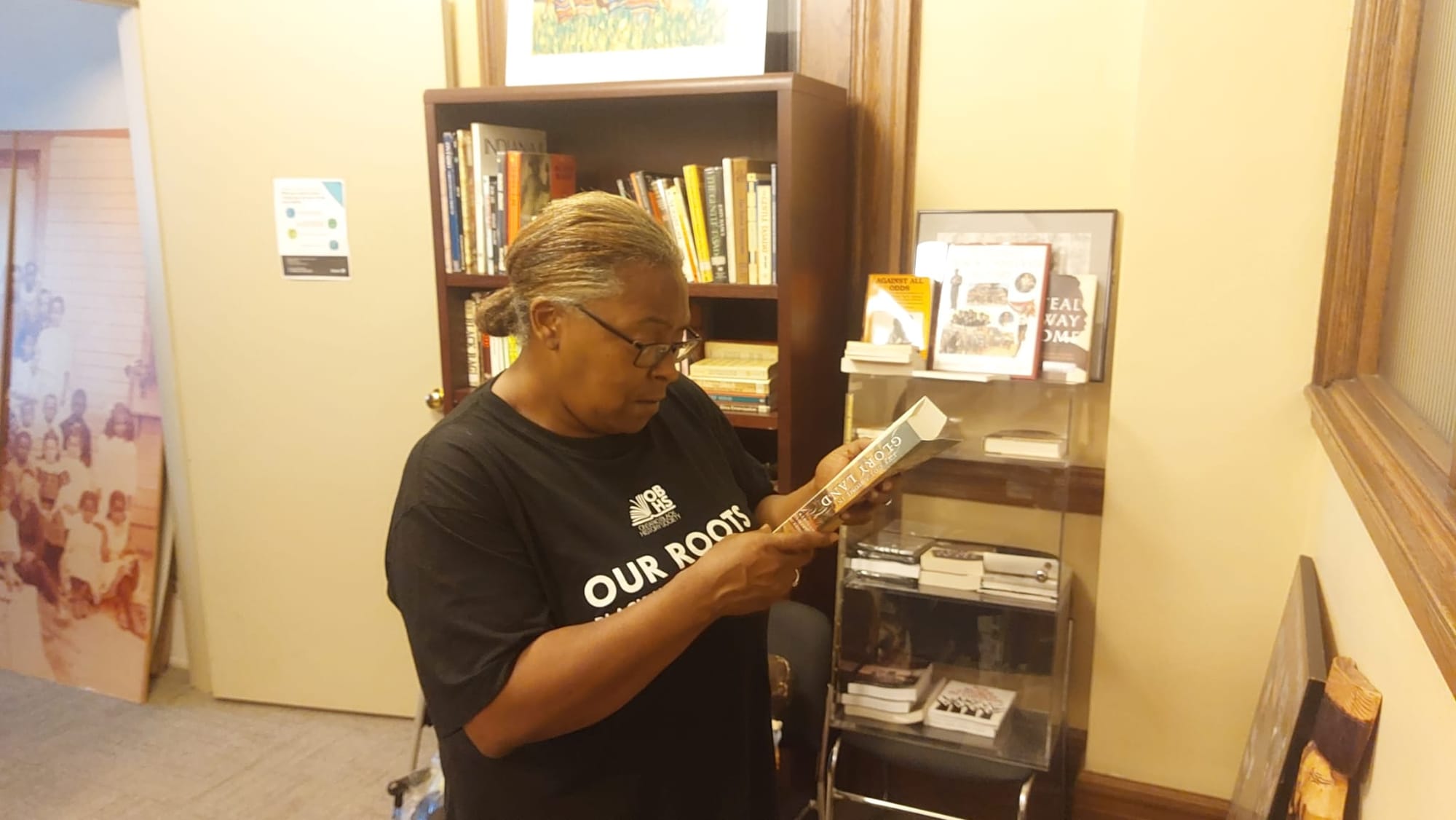
Houston took the tour group into the Ontario Heritage Centre, up the building’s manual elevator (operated by a friendly front-door receptionist), to the O.B.H.S. office on the fourth floor. She showed them the assortment of history books, photos, and memorabilia collected there over decades. Many of them were donated by the descendants of prominent Black figures, who were equally committed to preserving these artifacts for educational uses. “The community becomes a pen for documenting our history,” Grant told me.
The group was so enamored by these objects that they lost track of time. Houston checked the clock—almost 2:30 p.m. She knew they had to arrive at St. Lawrence Hall, the tour’s final destination, by their appointment time. Houston rushed the group from Adelaide to King. Ten minutes later, she led them to a grand hall on the upper level of the building. Through the booming acoustics, she told us about how this venue hosted the 1851 North American Convention for Colored Freemen.
In response to the United States passing the Fugitive Slave Act, which allowed escaped slaves and free Blacks in northern states to be recaptured, prominent Canadian abolitionists organized a conference at St. Lawrence Hall. This event helped establish the country as a haven for those seeking freedom.
Grant then gave a short lecture about No. 2 Construction Battalion, Canada’s largest all-Black army unit during the First World War. The group listened quietly and respectfully, absorbing all this new knowledge.
“Is this taught in schools?” one of the attendees asked. “If not, where do I sign up to make it happen?”
A spirited discussion followed about Ontario’s upcoming changes to its general curriculum, which will include new mandatory teaching of Black Canadian history. The consensus among the group seemed to be that it’s long overdue.
While the new proposed curriculum would expand on Black history education for Grades 7, 8, and 10, Wallace believed that this could start earlier—not just for the benefit of young Black children, but for all Canadian students. “It really adds more to the inclusion,” she told me, “because you have a better understanding of what people went through, to get to where they are today, and the work that still needs to be done.”
This recognition is slowly beginning at the government level. In 2021, Canada declared Aug. 1 to be Emancipation Day, commemorating Britain’s passing of the Slavery Abolition Act.
Every year on that day, Houston travels to Owen Sound for a gathering of all the descendants of her ancestor, the freeman John Green. This large family reunion has taken place for 163 years. Through years of integration and mixed marriages, many of Houston’s extended relatives aren’t just Black, and she’s enjoyed bonding with them at these annual gatherings, which she’s attended since she was a child.
“I still remember these old ladies—some were 99 years old, one was 100 years old,” Houston told me. “It’s weird how our elders have passed, and now it’s me, my sister, my brother, my cousins—our young people see us as the seniors.”
Being a steward of family history, and a broader people’s history, is an around-the-clock job, as Houston knows all too well. As the Hydro One tour concluded at St. Lawrence Hall, she received a phone call from back at the office. A young Black couple from Georgia, vacationing in Toronto, had read about the O.B.H.S. tours online, and came to 10 Adelaide Street East to inquire about attending one.
Houston was exhausted from this afternoon, but when returning to the office to greet them, she immediately lit up.
Comments ()