
Christmas in Camelot: The West Wing’s Seasonal Comforts and Quiet Myths
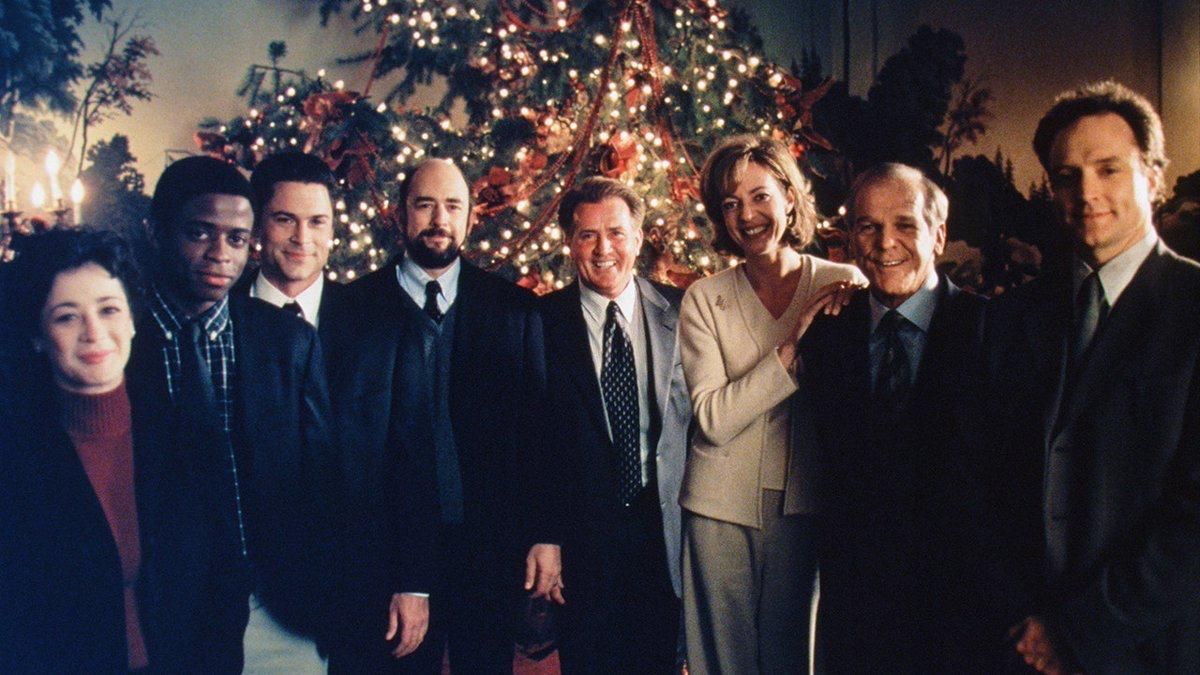
Revisiting The West Wing’s holiday canon, 25 years on, in search of warmth, meaning, and the myths we once found comforting.
I know my vast and erudite audience has come to expect deep, unflinching takes on the shortcomings of this most beloved series. However, in the spirit of the holidays (and at the behest of my editor), we are doing what is done best in this strangely comforting and utterly uncanny valley between Christmas and New Year's: going over seven seasons of The West Wing’s holiday episodes in an attempt to find some gold among the dust.
After all, if The West Wing excels at anything, it’s mythmaking turning bureaucracy into morality plays and political compromise into seasonal ritual. Christmas episodes, then, are where the show’s sentimentality is allowed to run completely unchecked—where grief, redemption, and good governance are wrapped in orchestral swells and tasteful pine garlands. What follows is not a ranking so much as an inventory of vibes, virtues, and quiet crimes against plausibility.
“In Excelsis Deo” – Season 1, Episode 10
We start off with a bang, not a whimper. If you are looking for a dose of realism with your holiday cheer, you have come to the right place. In Excelsis Deo happens to be the only West Wing episode to win an Emmy for Outstanding Writing for a Drama Series, and for good enough reason. Here, Toby is confronted with a dead homeless Korean War veteran discovered on a park bench—wearing the coat he donated to Goodwill with Toby’s business card still in the pocket. The scene sets up a rare moment where Toby’s grim pragmatism turns outward; he becomes fixated not on policy or press spin but on dignity. He tracks down the vet’s brother, tries to give the man the honour he never got in life, and ultimately arranges a full military funeral—back-channeling White House influence in ways that feel almost indiscreet, even reckless, for the sake of one forgotten life.
Meanwhile, in the lighter but equally telling subplot, Donna hands Josh a Christmas present list—the perfect ski-gear gift list for someone who very clearly has never skied—so that he can feel the moral weight of holiday gift procurement while still failing spectacularly at it. This episode also briefly touches on contemporary politics in a way that now feels both earnest and threadbare: C.J. and Leo debate the White House’s response to a hate crime against a gay teen, clearly riffing off the real-world Matthew Shepard case. It’s an admirable inclusion, even if the resolution—like so much in The West Wing—comes down to a few pointed lines wrapped in seasonal goodwill.
Then there is Mrs. Landingham, the precious heart of this episode. Her backstory—losing her twin sons to enemy fire in the Vietnam War on Christmas Eve—is one of the most devastating yet quiet character moments the show ever attempted. The way she tells it, with that quiet voice and constant, lingering grief, gives real weight to the episode’s central meditation: generosity is nothing without remembrance.
Then there’s Bartlet, in his innocent daydream of Christmas shopping in an antique bookstore—joyful, whimsical, almost embarrassingly normal for this strange, earnest show.
This episode is not light. It wrestles with homelessness, institutional indifference, the ghosts of war, and the desperate hope that compassion can be coaxed out of bureaucratic very-important-people.
And yes - 0.5 goldfish added for Danny putting the moves on C.J., because in a Christmas episode that can reach deep emotional seams, even that subplot still doesn’t quite land the way it’s clearly trying to.
3.5 out of 5 goldfish and that’s just because I miss Toby and Sam.
“Noël” – Season 2, Episode 10
Where do I begin? Some people have The Dark Knight Trilogy, others have the venerable Lord of the Rings, and others still prefer the fantastical and no less tropey Star Wars. For me, dear reader, the Holiday episodes of seasons 2-4 form the ultimate holy trinity of any comfort watching binge. We kick things off with one of the most decorated episodes in the entire series that introduces the flashback structure that will be used for the two episodes henceforth. The crux of the story deals with the aftermath of the Rosslyn shooting, as the incomparable Dr. Stanley Keyworth helps Josh face the trauma that he has been through while he tries to navigate the hectic rhythm of west wing life.
A prominent aspect of the episode is an AWOL fighter pilot who is refusing commands. Christmas tales are all about the out-there and morally inspiring tropes, and the pilot having the same birthday as Josh is as suspension of disbelief as it gets, while making us question the control that any of us truly have over our lives. Some of the subplots include Toby spreading Christmas cheer (the horror) and a stolen painting being returned to its rightful owners by a begrudging yet golden-hearted white house curator. The entire episode has a disquieting and anxious canter to it that is the true heartbeat behind the well-meaning facade of every Christmas.
5 out of 5 goldfish.
“Bartlet for America” – Season 3, Episode 9
This too is a flashback episode, with the White House staff dealing with the aftermath of the announcement of President Bartlet’s M.S. diagnosis. We go back and forth between Leo’s deposition in front of Congress and his lovely banter with his attorney, and the nascent Bartlet presidential campaign, where we see the still bright-eyed and bushy-tailed senior staff trying to come up with a policy strategy and have the return of the fan favourite, Mrs. Landingham. There is an ever-so-sweet callback to the previous year’s episode with Josh repeating the “guy who is stuck in a hole and has his friend jump in to help him” story back to Leo as he goes in for his deposition.
Overall, a solid episode and an effective emotional bridge between idealism and consequence. Leo’s loyalty is canonized, Josh’s faith is reaffirmed, and the show once again reassures us that the right people are in charge—even when they lie. It is comforting television, immaculately acted, and deeply invested in the idea that character is accountability enough.
4 out of 5 goldfish.
“Holy Night” – Season 4, Episode 11
And now, the finale of my favourite trilogy is upon us, and from here on out, you shall expect to hear nothing but slights and slander flung at feeble attempts to recreate past glories. And here is where - in the spirit of Holiday acceptance and mirth - I must confess, dear reader, I have from a very young age been infected with the Josh and Donna shipping virus. Please, please put the pitchforks down. I am nearly cured of my affliction.
Another Christmas episode sees us flashback once more - this time to Toby’s dad and his dastardly mob-related deeds in the middle of the last century. All while Toby undergoes the first of many depositions (oh, how young we were then), this one related to his ex-wife’s pregnancy as she is being sued by her constituents for not disclosing a disability before being elected to office.
We also welcome back the inimitable Danny Concannon to the White House press pool, where he resumes flirting with C.J. while simultaneously investigating the state-sanctioned assassination of Abdul Shareef. A journalist asking uncomfortable questions at Christmas is, frankly, a miracle—and a passing win for freedom of the press is worth at least half a goldfish in my books.
Unfortunately, we are not spared the introduction of both Jean-Paul and Will Bailey in this episode. With Sam Seaborn reduced to campaign posters haunting the bullpen like a benevolent ghost and no corporeal Sam to offset them, the ensemble suddenly feels at least 50% more pretentious and less clever.
The highlight for me, of course, lies in the true beginning of Josh and Donna’s idiots-to-lovers arc. Donna is about to jet off for the holidays with Christian Slater’s Jack Reese, and Josh is—unsurprisingly—deeply unwell about it. Donna fares no better, lingering far past reason while Josh is buried under a last-minute policy demand from Leo. This culminates in Josh’s immortal “This is not what it looks like,” as he asks Donna to stay and help, promising mind-blowing after-hours entertainment in the press room—prompting her entirely reasonable request for clarification.
The whole idiotic affair is mercifully ended by Leo’s pragmatic intervention, as he apologizes to Josh for commandeering a helicopter to transport Donna to her new beau and delivers the immortal line (at least in my canon): “Oh, will you get it together.” I swoon every time.
By the end, all storylines are strangely resolved, and we retire into a peaceful holiday bliss. Half a goldfish added for the official ignition of idiots to lovers; half a goldfish subtracted for Will Bailey.
4.5 out of 5 goldfish, and may the lord have mercy on my soul.
“Abu el Banat” – Season 5, Episode 9
With Sorkin’s departure, there is a perceptible drop-off in the quality of the holiday episodes. As if by way of apology, we are given Ellie Bartlet and Debbie Fiderer—who, by all available evidence and rigorous personal accounting, absolutely carry this episode. President Bartlet is tasked with the near-impossible feat of getting his three daughters in the same room for Christmas dinner while also indulging his ever-underwhelming son-in-law’s truly inspired idea of running for Congress.
Threaded through this domestic chaos are a number of errant plotlines that never quite cohere: the rescue of aid workers in Sudan, a physician-assisted suicide bill, Josh finally managing to procure Donna an actual, physical gift, and Bartlet granting his camera-shy grandson the private honour of turning on the White House Christmas tree. These moments feel less like a unified narrative and more like a checklist—each one competently executed, none allowed to linger long enough to resonate.
Still, the family beats land. Ellie’s quiet presence and Debbie’s unflappable calm offer a welcome reprieve from the increasingly frenetic moralizing of the later seasons. And because my grandfather was the most important person in my life, I grant the tree-lighting an additional half goldfish on deeply subjective grounds.
3.5 goldfish in all.
“Impact Winter” – Season 6, Episode 9
Probably one of the least jolly holiday episodes of them all. We follow the staff as they grapple with President Bartlet’s M.S. episode during a trip to China, where he is temporarily unable to use his legs. A fleeting moment of domestic bliss between Josh and Donna—breakfast, normalcy, the illusion of choice—is quickly undercut by Donna’s attempt at the announcement that she is leaving for the Hoynes campaign.
We are then hurled into the entirely forgettable asteroid plotline, which functions less as tension and more as narrative white noise. Bonus points, however, to Ginger, Margaret, and Carol for pragmatically planning to repopulate the earth while excluding the male senior staff. Sensible.
The episode closes with Donna finally being free of the shackles of her devotion to the White House and Josh, almost reflexively, beginning the Santos era. It is transitional television — necessary, but joyless.
I give this episode 2.5 out of 5 goldfish, and the half is for Donna finally getting the courage to leave.
“The Wedding”- Season 7, Episode 9
Ellie, my darling—for you alone, 3 goldfish.
The rest of the episode is a study in late-season diffusion: campaign anxieties, geopolitical maneuvering involving Russia and China in Kazakhstan, and Will Bailey being forced to deal with the wedding—which, frankly, serves him right. The episode wants to feel celebratory, but it’s weighed down by the sense that everyone is already somewhere else, politically and emotionally.
And finally: “Why is Will Bailey wearing a tux?”Ellie Bartlet, confirmed Will Bailey hater. On this, we agree.
0.5 goldfish for Josh and Donna on the stairs at the reception, and “I’m an attractive woman waiting to be entertained.” He truly does not deserve you, my love.
3.5 goldfish for the road.
Conclusion
Here I leave you, my dear readers. 25 years into the Bartlet administration that never was. A presidency preserved in snow globes and swelling strings, still oddly persuasive in its promise that decency alone might be enough.
Stay tuned in the coming year for more biting and culturally relevant critique. The holidays may offer comfort, but the reckoning, as ever, resumes in January.
Comments ()