
Proximity, Power, and Pining: Josh and Donna Revisited
Seven seasons of charged glances, emotional repression, and HR violations narrowly avoided—revisiting Josh and Donna’s romance 25 years on.
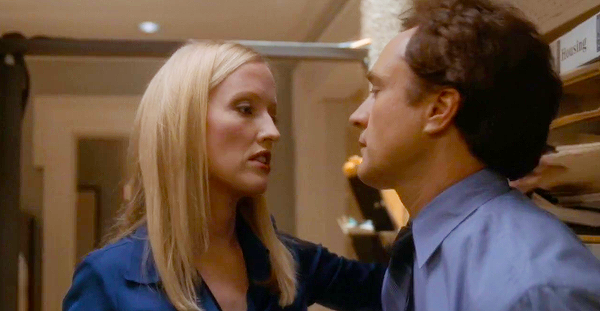
The days are still bitterly cold, the memory of the mirth of holidays past is nothing but a distant flicker in our rearview mirrors, and the tepid tendrils of capitalism crawl out of every orifice demanding our sacrifice of dollars and chocolate. Which means that it is Valentine’s Day. Which means that it is the perfect time to talk about love. In the context of the ever-present West Wing that looms like the halcyon days of the halcyon days, of course.
And if the series gave us soaring speeches, constitutional crises, and a suspicious number of walk-and-talks conducted at near sprinting speed, it also—somewhat accidentally—gave us one of television’s most enduring slow burns. A romance so prolonged, so bureaucratically entangled, that it feels less like courtship and more like policy development.
It is a truth universally acknowledged that no one on the writing staff knew how to handle a romantic subplot. From Sam’s short-lived affair with Laurie which kickstarted the series and was then relegated to a mere footnote, to C.J. 's entirely too drawn-out courtship with Danny Concannon, punctuated by a tragically Shakespearean affair with her bodyguard, to Charlie and Zoey’s seven-year situationship from the pits of hell. Underneath all this chaos, the steady rhythm of Josh and Donna’s quips, prolonged stares, and entirely co-dependent tendencies provided a strange sense of stability and comfort.
The first episode of The West Wing aired just a few months after the tragic deaths of JFK Jr. and Carolyn Bessette Kennedy—a romance that I’ve been told captivated the American public. You can’t help but see remnants of this infatuation in Josh and Donna: the blonde, down-to-earth outsider ingénue and the curly-haired, smart-talking political operator attorney. Truly, the resemblance is uncanny. Which makes the decision to prolong the courtship ever more perplexing and, at the same time, inevitable. One can only survive on charged glances and near-confessions for so long before the audience begins to feel like an unwilling participant in emotional brinkmanship.
Proximity and hierarchy. It’s all under the surface—more about what is unsaid than said.
In the early seasons, their relationship thrives precisely because it is structurally contained. Donna is always just outside the door, just out of frame, the first and last voice Josh hears in a day governed by catastrophe. Their intimacy is built in fragments: late nights, campaign war stories, gift exchanges that are never really about the gifts. The humour disarms what the hierarchy would otherwise make inappropriate.
What makes this era so effective is that the show understands restraint. Donna knows Josh’s mind better than anyone in the building; Josh relies on Donna emotionally in ways he cannot articulate professionally. And yet the line never quite breaks. The romance exists in negative space—in pauses, in glances, in the way proximity becomes its own language. It is comfort television not because it resolves, but because it refuses to.
And yet, the very architecture that makes the relationship compelling is also what makes it untenable.
The assistant/deputy chief of staff dynamic creates a romantic asymmetry the show can never fully reconcile. Donna’s emotional labour is constant—steadying Josh, translating his chaos, absorbing the fallout—while her professional growth stalls in his shadow. The audience is meant to read this as devotion; on harsher days, it reads as stagnation.
The will-they-won’t-they tension depends on imbalance. For the romance to progress, the structure sustaining it must collapse. Which, of course, it eventually does.
If the earlier seasons allowed Josh and Donna to live comfortably in the romance of possibility, the post-Sorkin years begin to test what happens when that possibility edges toward reality. Which is why it all nearly crumbles in the brave new world of the Santos administration. They are no longer the bright eyed and power hungry rookies. They are ruthless political operators, and can love really be sustained out in the open, with all the flaws and conflicting schedules of two chiefs of staff aired out?
And so we arrive, inevitably, at the emotional thesis that had been simmering beneath seven seasons of almosts:
Delayed gratification. Or maybe perpetual frustration on the viewers’ ends. Which is perhaps something that we can all learn from. Or maybe not. For who has the time to wait patiently by the propped-open door for your co-dependent boss to yell out your name in a bout of pure desperation and thinly veiled longing? One thing my two favourite idiots-to-lovers made me realize is that I can only operate in the extremes. That I have no patience in the realm of the romantic. That I am always at the end before there is even a beginning. Perhaps a slow burn, as frustrating and comforting as this one is, can give an opportunity to slow down. To live in the present without the burdens of all the encroaching futures. To find beauty in the errant touch or gaze without it having to mean anything beyond what it is. That is a gift in itself, I think. Especially in our age of ever-shortening attention spans and disposable attachments. Happy belated Valentine’s Day, Dromline.

Comments ()